



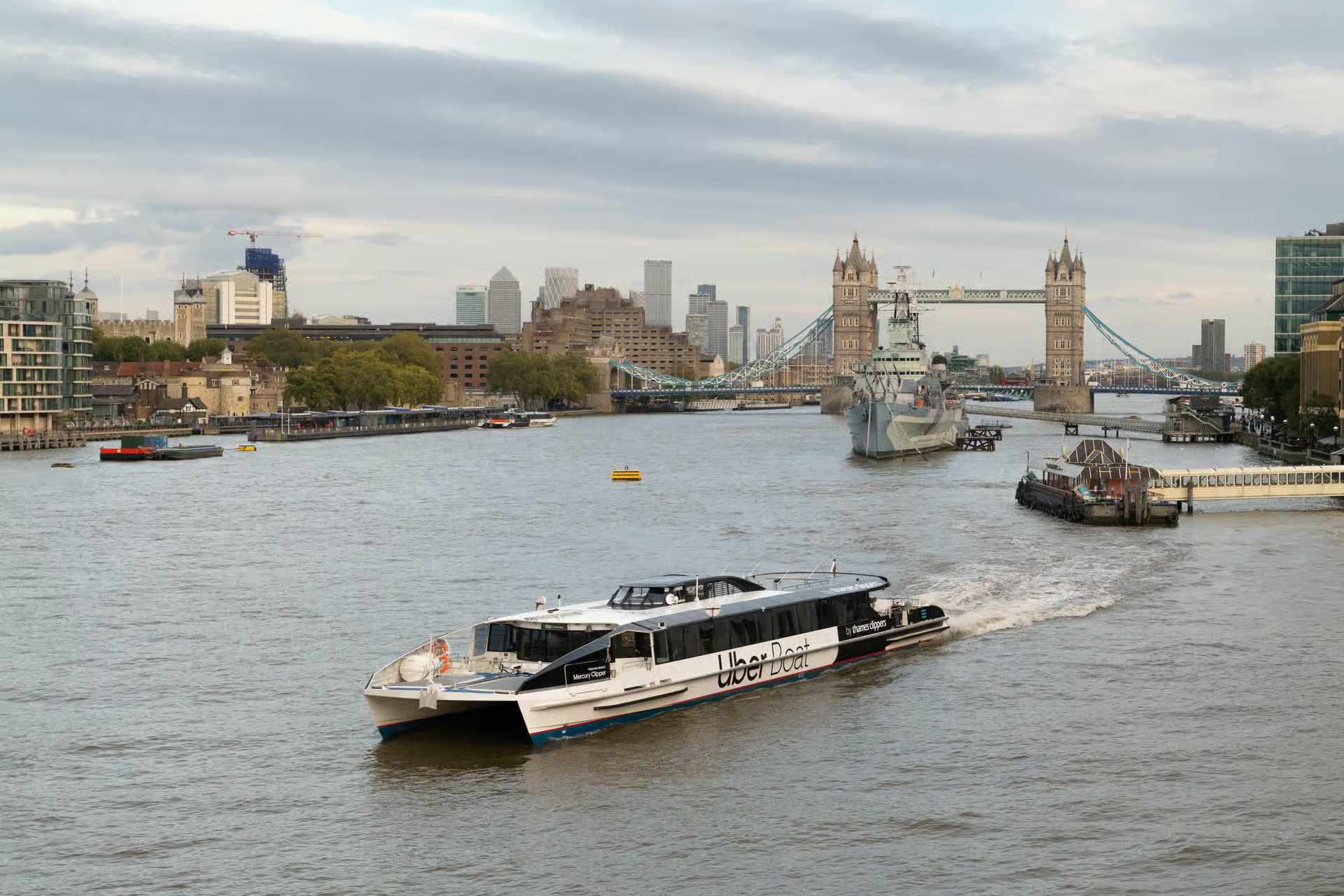
The river service that began with one boat and around 80 passengers a day, now carries almost 6 million passengers a year. Over a quarter century in operation, Uber Boat by Thames Clippers has become part of the city’s natural rhythm. It’s used by Londoners traveling pier to pier and by visitors seeking a unique view of the capital from the waterline.
That blend is at the heart of the story Alison Murphy, Director of Sales, tells about the business today. Though Thames Clippers was already a familiar part of life on the Thames, a partnership with GetYourGuide helped it cast a wider net. Infrastructure built into the daily routine of London now reaches more travellers planning their time in the city or looking to book an experience upon arrival.
While the fleet moves 10,000 passengers a day, most of that traffic is anonymous: locals using contactless tap-in, tap-out travel. More online bookings put a face to passengers. It gave the team a way to see who was booking, where they were coming from, and what they really wanted to experience on the water.
For Alison, that opened up clear room for growth. A well-used part of London’s transport network – the same boats that keep the city moving – could become a destination in its own right. The business could unlock more revenue simply by making better use of the seats it already had.
What did GetYourGuide change for the business?
The biggest shift was reach. While the service was already a landmark on the river, GetYourGuide provided global shelf space. It placed the brand in front of an international audience that might otherwise have overlooked Uber Boat by Thames Clippers as a local transit option. Alison says the platform “helps to get our product out to other areas” and to different visitor groups.
That reach has been especially useful in Europe. The business has seen more visitors from Spain than ever before, and travellers from France, Italy, and Germany are among the strongest bookers on GetYourGuide.
For the team, that mattered because it opened a market they would have found much harder to build country by country on their own.
“It’s easier to partner with someone that’s going to act as a window to the European market, rather than us trying to figure out how to tap into the Spanish or Italian markets,” Alison says. “GetYourGuide does it for you.”
What did they learn from those bookings?
They learned more about who was coming and when. Most commuting passengers tap in and tap out or buy at the pier using contactless or Oyster Cards. OTA bookings gave the team a different perspective. They could see demand in advance and get a clearer picture of leisure before the day of travel.
Alison says that visibility has value in itself. “It’s nice to know in advance who’s coming on a certain day and having that intel about your customer. With tap-in, tap-out, you don’t have advanced information about them.”
She has also seen a pattern in how some traveller's book. In some cases, people seem to book within three days of travel. That suggests the product is catching people at different moments, not only in the planning stage before a trip, but also after arrival, when they are deciding how to fill time in the city.
That changes how a river service can be sold. It is transport, though it can also become part of the day’s experience.
How did digitisation unlock opportunity?
Despite its 2020 partnership with Uber, which gave the service greater public visibility, the company’s ticketing system could not integrate properly with OTAs before the current setup.
It introduced a real commercial limit. The ambition to work with third-party partners was there from the start, but the technology simply couldn’t support it. As Alison puts it: “We always wanted to work with third parties, but when your ticketing system is very controlled, it made it difficult. Our tech stopped us from being able to.”
The problem was not the product; the problem was access. A restrictive system made it difficult to show up where travellers were actually looking for things to do.
The turning point came with a move to a new digital ticketing system that was custom-built for tour operators. That finally removed the barrier that had been blocking outside integrations and gave the business an all-in-one ticketing system. From there, the GetYourGuide connection became much easier to manage.
Alison says partnering with GetYourGuide “meant the integration through the API was so seamless for uploading products and having real-time availability.” That changed the practical side of selling. It also changed boarding. GetYourGuide tickets could be scanned the same way as the company’s own-issued tickets. It proved to be a game-changer. Alison explains, “The barriers we had for integration were removed.”

What did the team do with more flexibility and more ways to sell?
Unlocking the potential of OTAs like GetYourGuide gave the team more freedom to decide what to sell and how to sell it.
Alison points out that it helped to have “a way where you can decide which products you want to list, not necessarily the entire portfolio but the ones that truly fit.” That makes a difference for a business like this. This flexibility allows the team to curate the best offerings for different journey types, from single-leg transits to multi-day packages.
As the team got more comfortable with the system, they started getting creative and expanding their offering. “As we’ve developed and grown more confident with the process, we’ve been able to introduce far more products as a result of how seamless it is,” Alison says.
Alongside core river tickets, the business now offers products tied to the London Cable Car, hop-on hop-off sightseeing passes, an evening river tour, and a riverside afternoon tea experience.
Where is the tide turning next?
Uber Boat by Thames Clippers is no longer a small operator finding its footing. It is a long-established part of London’s transport infrastructure, with over a quarter of a century of experience, 23 boats in operation, and more than 60 million passengers since 2010.
The story shows is simpler than the scale might suggest. Once the technology stopped blocking progress, the business could grow at pace.
Opportunity now lies in building on that momentum. By removing technical barriers to growth, a historic river route has successfully evolved into a modern, global attraction. In turn, that has made the Thames more accessible to everyone who visits the city, and to the commuters that rely on it day to day.
Key takeaways
- From one boat and around 80 passengers a day to almost 6 million passengers a year. Uber Boat by Thames Clippers turned a long-established London river service into a stronger draw for international travellers. Growth continued with GetYourGuide since 2024.
- A restrictive legacy ticketing system had blocked OTA growth. Embracing a new digital setup removed the integration barrier, enabling a direct GetYourGuide connection.
- Real-time API integration and scannable GetYourGuide tickets. A smoother tech setup made product uploads, availability, and boarding much easier to manage.
- More control over product listing. The team could grow the offer over time, from core river tickets, to seasonal products like Illuminations cruises to Cable Car combinations, hop-on hop-off passes, evening tours, and afternoon tea experiences.
- GetYourGuide opened the door to more European demand. Countries like Spain, France, Italy, and Germany are now among the strongest booking markets.
- Advance booking visibility gave the team a clearer read on leisure demand. They can now see who is coming, when they are booking, and how a transport service can also be sold as part of the London experience.